Ethnographic Study on Fitness Trackers, Environments, and Social Contexts
Ethnographic study on the interplay between how environment and social context shapes fitness tracker use
Observation studies, analysis coding, and experimental design
As part of a graduate ethnography course, I collaborated with two classmates to investigate how people use fitness trackers during physical activity, the social contexts surrounding exercise, and how workout environments influence behavior. Our goal was to better understand how wearable technology could be personalized to encourage physical activity and support overall health.
I conducted participant observation at a mall with both indoor and outdoor walking areas, observing people using fitness trackers during their workouts. I spent one hour observing participants each day for 17 days, documenting their behaviors and interactions through detailed field notes.
Our team also conducted semi-structured interviews and later collaborated on coding and analyzing our observational data. During the analysis, I contributed to identifying patterns in how participants interacted or did not with their wearable devices while exercising.
Our analysis revealed that although wearable devices were commonly present, participants rarely actively engaged with them during physical activity. We also identified differences in observed exercise behaviors across genders: men more frequently engaged in higher-intensity activities such as running and biking, while women more often participated in lower-intensity activities and were more likely to engage in concurrent social distractions, such as conversations with others.
We synthesized these findings into a final research paper presented to the class.
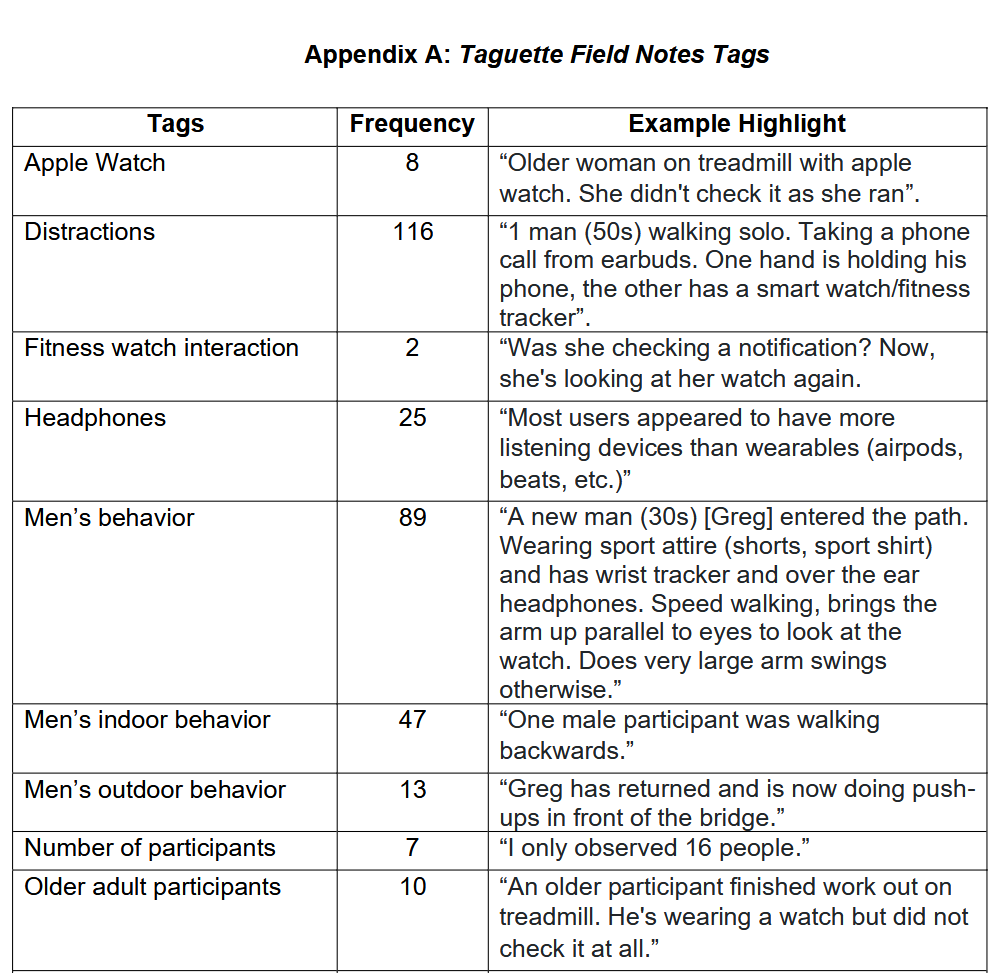
A portion of the tags associated within the notes, their frequency, and an example
Click the image below to read the full report
or [CLICK HERE]